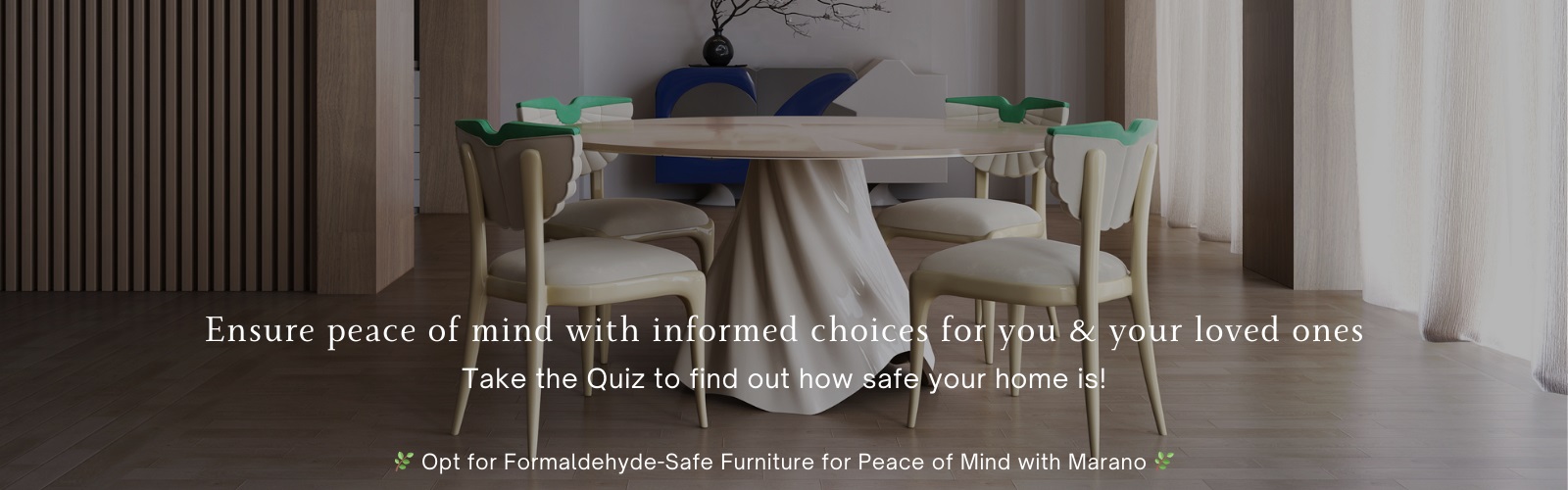
How Safe is Your Home in Protecting the Well-being of your Loved Ones?
Formaldehyde emissions from furniture can impact your health, especially for children and those with allergies. Prolonged exposure to formaldehyde can pose several other adverse health effects:
Respiratory Issues: Prolonged exposure to formaldehyde can cause respiratory problems, such as coughing, wheezing, and chronic bronchitis.
Skin Irritation: Contact with formaldehyde can lead to skin irritation and allergic reactions, including dermatitis.
Eye Irritation: Formaldehyde vapours can cause eye irritation, leading to redness, itching, and a burning sensation.
Cancer Risk: Formaldehyde is classified as a human carcinogen, and long-term exposure has been linked to certain types of cancer, particularly nasopharyngeal cancer and leukaemia.
Headaches and Dizziness: Exposure to formaldehyde can cause headaches, dizziness, and nausea.
Immune System Effects: Prolonged exposure to formaldehyde may also affect the immune system, potentially leading to weakened immune responses.
These adverse health effects of formaldehyde exposure have been widely studied and reported by various reputable health organisations including WHO Guidelines for Indoor Air Quality: Selected Pollutants and Formaldehyde in Indoor Air by the U.S. Environmental Protection Agency (EPA).
Take our quick quiz below to find out how safe your home is in protecting the well-being of your loved ones. Discover how your answers impact your need for formaldehyde-safe furniture and learn why it matters for your health and well-being.
Quiz & Explainers
1. How often do young children play on the floor near the furniture in your home?
A) Daily
B) Several times a week
C) Occasionally
D) Rarely
Why It Matters: Young children are closer to the floor and often spend more time playing there, increasing their exposure to formaldehyde emissions. Formaldehyde tends to saturate at lower levels, putting children at greater risk. If children are frequently playing near new furniture, it’s preferable to opt for low-emission, formaldehyde-safe options.
2. How sensitive are you or your loved ones to indoor air quality, and do you experience any of the following symptoms?
A) Very sensitive (allergies, asthma, frequent headaches, or dizziness)
B) Moderately sensitive (occasional symptoms like mild allergies or skin irritations)
C) Not very sensitive (rarely any symptoms)
D) Not sure
Why It Matters: Formaldehyde exposure can cause or exacerbate symptoms like allergies, asthma, headaches, and skin irritations. If you or your loved ones experience these symptoms, reducing formaldehyde exposure by choosing safer furniture can help improve health and comfort.
3. How well-ventilated is your home, especially if you run the air conditioning all day?
A) Poorly ventilated, windows are always closed with air conditioning running constantly
B) Moderately ventilated, sometimes with open windows
C) Well-ventilated, with windows often open
D) Not sure
Why It Matters: Poor ventilation, especially with constant air conditioning and closed windows, can lead to higher concentrations of indoor air pollutants, including formaldehyde. Ensuring good ventilation and choosing formaldehyde-safe furniture can significantly improve indoor air quality and health.
4. Did you ask about the formaldehyde emission level when you purchased your furniture?
A) No, I didn’t know I should check
B) No, but I’m concerned now
C) Yes, and I chose E1 (low emission)
D) Yes, and I chose E0 (very low emission)
Why It Matters: Understanding the formaldehyde emission levels of your furniture is key to making informed decisions. E0 and E1 grades indicate low emissions, with E0 being the safest. E1 grade furniture is suitable for general use but may not be ideal for highly sensitive individuals or poorly ventilated rooms.
5. Do you often notice strong odours from new furniture in your home?
A) Yes, frequently
B) Sometimes
C) Rarely
D) Never
Why It Matters: Strong odours from new furniture can indicate higher levels of formaldehyde emissions. If you frequently notice these odours, your furniture is likely emitting higher levels of formaldehyde, which can contribute to poor indoor air quality and health issues.
6. How long do you think formaldehyde emissions from furniture can last in your home?
A) A few weeks
B) A few months
C) Several years
D) I’m not sure
Why It Matters: Formaldehyde emissions can persist for several years, gradually decreasing over time. Choosing furniture with low formaldehyde emissions helps ensure long-term indoor air quality and reduces prolonged exposure to harmful chemicals.
Here is the quiz result!
Based on your answers to questions 1 to 5, here’s a gauge to help you understand how much you need formaldehyde-safe furniture.
Mostly A’s and B’s:
You have young children playing near furniture daily or have family member who experiences symptoms several times a week, like allergies or asthma, and/or has relatively lesser open-air ventilation. E0 grade furniture, with the lowest formaldehyde emissions, is highly recommended.
Mostly C’s:
You occasionally have children playing near furniture, rarely have any family member who experiences symptoms and has moderate ventilation. E1 grade furniture may suffice, but open-window ventilating or adding an air purifier would be recommended. E0 would be ideal for better protection if symptoms persist.
Mostly D’s:
You rarely have children playing near furniture, may not have any family members who experience symptoms, and/or have well-ventilated spaces. E1 grade furniture should be adequate for your needs, but if you’re concerned, opting for E0 offers extra peace of mind, as formaldehyde emissions are not limited to allergies but also include carcinogenic risks.
Formaldehyde-safe Furniture
At Marano Furniture, we prioritise your health and well-being by offering a range of stylish, formaldehyde-safe furniture options. Explore how far we go to protect our users’ well-being at https://maranofurniture.com/fusing-sustainability-with-stylish-solutions/ and discover how you can enhance your home’s air quality while maintaining impeccable style.
For pet lovers, check out our pet-friendly upholstery like eco-leather which is formaldehyde-free and can be applied to any of our sofas from Marano Living.
For further information, contact our customer support for assistance.